
A mislabeled product rarely costs you one label. It can cost you an entire workflow.
One barcode error can trigger:
- shipping delays
- chargebacks
- inventory inaccuracies
- manual rework
- customer complaints
- lost production time
And in many operations, the real damage is not discovered until the product has already shipped.
That’s the labeling paradox: The cheapest item on the floor can create some of the most expensive operational disruptions in your operation. Modern manufacturers, warehouses, and distribution centers are beginning to rethink labeling entirely; not as a commodity process, but as a critical control point for data accuracy, traceability, and operational resilience.
The Hidden Cost of Labeling Errors
Most operations leaders can quickly calculate the visible costs of a labeling mistake:
- wasted labels
- scrap material
- relabeling labor
- production interruption
But the real financial damage usually comes from the disruptions that follow.
The True Cost of a Labeling Error
| Visible Costs | Hidden Operational Costs |
|---|---|
| Reprinting labels | Shipping delays |
| Scrap materials | Customer chargebacks |
| Manual relabeling | Inventory inaccuracies |
| Labor time | ERP data corruption |
| Production downtime | Lost productivity |
| Returned product | Compliance risk |
Most organizations focus on the left side of the table. The operational disruption on the right side is often far more expensive. When a mislabeled product reaches the shipping dock (or worse, the customer), the problem quickly expands beyond the production floor.
How Labeling Errors Snowball
A single barcode issue can create a chain reaction across multiple departments.
Logistical Friction
Returns processing, reverse logistics, and manual investigation consume valuable labor and shipping resources.
Distributor Penalties
Many modern distribution centers rely on automated scan-based receiving systems. If a barcode fails to scan or references the wrong SKU, suppliers can face chargebacks or compliance penalties.
Inventory Inaccuracy
If your ERP system believes 500 units exist under one SKU, but those products are mislabeled under another, forecasting, purchasing, replenishment, and production scheduling all become unreliable.
Customer Trust Erosion
Repeated labeling mistakes damage confidence with customers, distributors, and retail partners.
The key to preventing these cascading costs is simple: Catch errors as early in the process as possible — ideally at the exact point where the label is created.
Batch Printing vs. Point-of-Use Printing
One of the biggest decisions in labeling operations is determining where and when labels should be printed.
Traditionally, many facilities relied on centralized batch printing:
- labels printed in large quantities
- labels distributed alongside work orders
- operators manually applying labels later in production
While this approach may appear cost-effective on paper, it can create operational vulnerabilities by leaving leftover labels “out in the wild”. For example, if a job requires only 480 labels but a batch of 500 is printed, those 20 extra stickers often remain at the workstation, get mixed into future jobs, or accidentally be applied to the wrong parts during a chaotic shift change. That is exactly where labeling errors begin.
Traditional vs. Modern Labeling Workflows
| Traditional Batch Printing | Point-of-Use Printing |
|---|---|
| Labels printed in bulk | Labels printed on demand |
| Leftover labels create risk | Eliminates rogue label inventory |
| Higher chance of mix-ups | One-to-one print/application process |
| Centralized bottlenecks | Distributed efficiency |
| More manual verification required | Automated validation workflows |
Point-of-use printing changes the process entirely. Instead of generating labels hours before use, compact desktop or mobile printers generate labels dynamically at the workstation during production.
This creates a direct relationship between:
- the product being built
- the ERP data being referenced
- the label being applied
The result is dramatically improved accuracy and traceability.
Building a More Reliable Labeling Workflow
Modern labeling environments work best when hardware, software, and ERP systems operate together as a unified workflow. A highly effective approach is what many organizations refer to as data triangulation; constantly validating multiple data points before a label is ever applied.
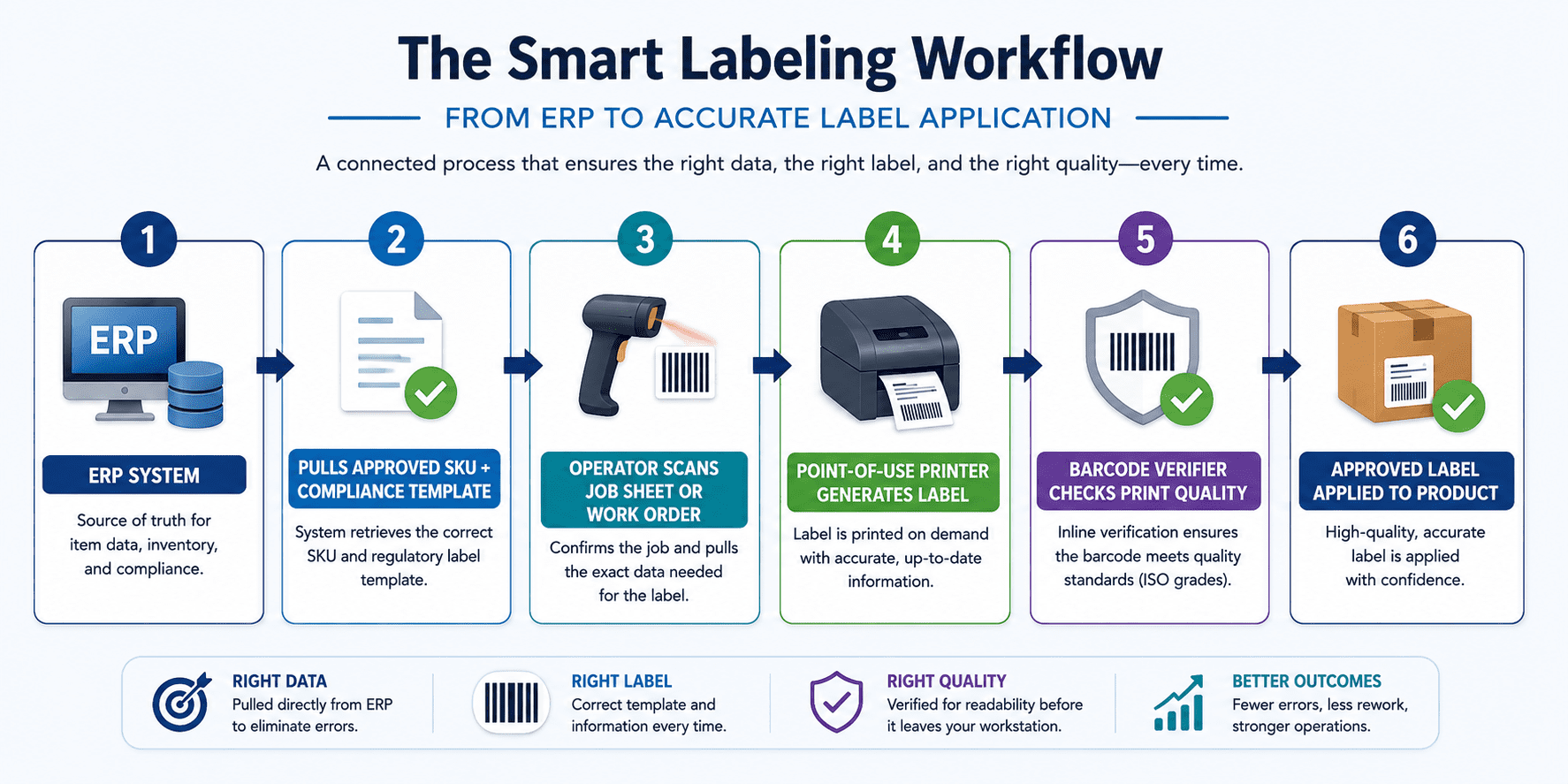
With modern labeling platforms like Loftware Cloud, operators no longer need to manually type complex part numbers or compliance data. Instead, an operator simply scans a localized production run sheet, allowing the system to instantly pull live data directly from the ERP system and automatically select the correct template. The printer then receives the approved label information instantly, completely removing manual data entry, one of the largest single sources of labeling errors in the entire production process.
Validation vs. Verification: Why Both Matter
These two concepts are often confused, but they solve completely different problems.
| Function | Purpose | Prevents |
|---|---|---|
| Data Validation | Confirms correct ERP/SKU data | Wrong product labeling |
| Readability Verification | Confirms barcode scans properly | Scan failures downstream |
“Is This the Right Data?”
Data validation ensures the information embedded in the barcode matches the correct item.
Modern systems accomplish this by:
- pulling data directly from ERP systems
- eliminating manual typing
- automating template selection
- validating production data before printing
This dramatically reduces the risk of:
- incorrect SKU labeling
- shipping mismatches
- production errors
- compliance issues
Readability Verification
Readability verification focuses heavily on the physical quality of the print itself, ensuring that even if the data is correct, the barcode can still be scanned seamlessly downstream. In busy production environments, factors like printhead damage, ribbon wrinkles, poor contrast, or ink smudging can easily produce unreadable barcodes that disrupt automated logistics further down the line. Advanced operations solve this issue by attaching inline barcode verification systems and fixed scanners directly onto their industrial printers. As each label is printed, these optical scanners instantly analyze the physical characteristics of the barcode, checking the edge definition, barcode quality, spacing consistency, and overall print grade against strict mathematical ISO standards.
If a barcode fails to meet these rigorous quality thresholds, the integrated system acts as an immediate quality control mechanism. The software can automatically halt production or instruct the printer to retract the faulty label, print distinct void marks across it, and seamlessly generate a clean reprint right on the spot. By automating this inspection process, unreadable labels are reliably intercepted and corrected at the individual workstation before they ever have a chance to leave the facility.
Moving From Reactive to Proactive Operations
Many facilities unknowingly build secondary inspection layers because they do not fully trust their labeling process.
That often leads to:
- manual pallet scanning at shipping
- redundant quality checks
- additional labor requirements
- downstream troubleshooting
In other words, employees spend valuable time “checking the checker.” Modern labeling systems fundamentally change that model.
A secure labeling workflow should prevent errors, not rely on downstream employees to catch them.
By automating validation and verification directly at the workstation, organizations can transition from reactive correction to proaction prevention.
That shift has a significant operational impact. Instead of discovering a major labeling issue days or weeks later through customer complaints or shipping failures, errors are identified and corrected immediately at the source.
The difference in cost between those two scenarios can be enormous.
The ROI of Labeling Automation
At first glance, investing in point-of-use printers, inline verification systems, cloud labeling platforms, and deep ERP integrations may appear to increase upfront operational costs. However, the return on investment often becomes clear very quickly when organizations look past the initial capital expense and measure the real-world savings that follow. True cost optimization is achieved through lower rework expenses, improved inventory accuracy and reduced compliance risks.
The real value of a modern labeling system is not simply faster label printing. The value lies in the complete elimination of systemic risk and the creation of a seamless, error-free workflow. By transitioning from a reactive approach, where time and money are spent hunting down and correcting mistakes, to a proactive system that prevents errors at the source, you protect both your bottom line and your customer relationships.
Building a More Resilient Supply Chain
Modern supply chains depend on accurate, uninterrupted data flow between:
- ERP systems
- warehouse operations
- production environments
- shipping processes
- customers and distribution partners
Labeling sits directly at the center of that ecosystem. Optimizing your labeling operation is not simply a printer upgrade. It is a strategic investment in operational consistency, traceability, and resilience.
By combining:
- point-of-use printing
- intelligent ERP integration
- automated validation
- barcode verification technology
organizations can reduce costly disruptions while improving operational confidence across the entire supply chain.
Key Takeaways
Modern labeling operations are no longer just about printing barcodes. Today, they serve as a core foundational pillar of a healthy supply chain. When you shift your perspective from treating labeling as a simple commodity to viewing it as a critical part of your production line, it becomes a powerful mechanism for driving facility-wide efficiency.
Specifically, a fully optimized, data-driven labeling framework acts as a safeguard for your daily operations by:
- Protecting inventory accuracy by ensuring that physical products and their digital enterprise records always match perfectly.
- Reducing operational disruptions and unnecessary shipping delays caused by mislabeled packages or mixed-up parts.
- Improving scan reliability downstream so that automated distribution center scanners can easily read your barcodes without friction.
- Minimizing manual rework and the hidden labor costs associated with scraping off incorrect labels or re-boxing orders.
- Maintaining compliance with strict customer templates and evolving industry standards.
- Strengthening customer trust by delivering exactly what was ordered, precisely when it was promised.
Ultimately, the most effective operations do not wait to discover labeling problems downstream when a customer calls with a complaint or a distributor issues a financial penalty. Instead, they proactively prevent errors at the exact moment the label is created right at the individual workstation. For practical help getting your labeling operations in check and exploring modern point-of-use systems, please contact us this month to schedule a labeling audit.